

A New Era of Global Space Collaboration
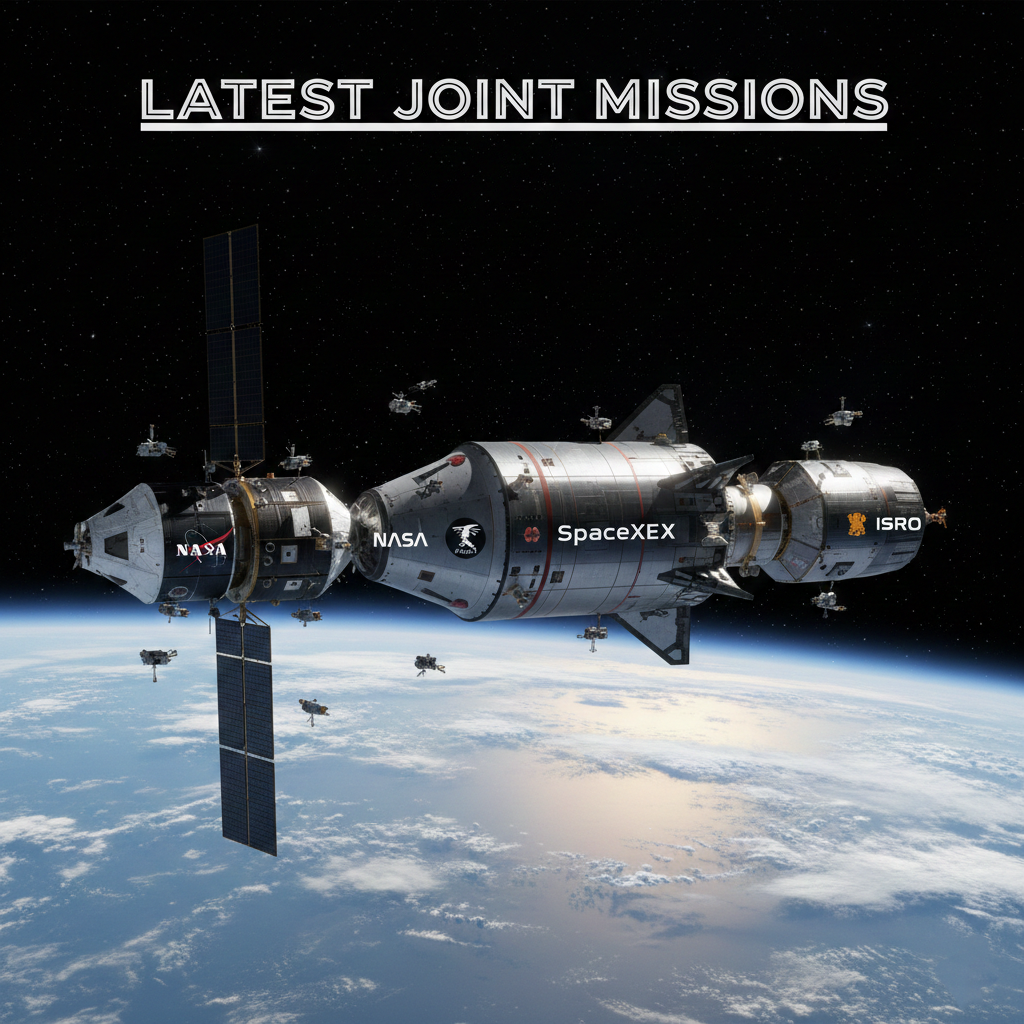
Space exploration has entered a powerful new phase where international collaboration is no longer optional—it is essential. In recent years, NASA, SpaceX, and ISRO joint missions have gained global attention, symbolizing how government space agencies and private aerospace companies are working together to push the boundaries of science, technology, and human ambition.
From crewed missions to the International Space Station (ISS) to Moon and Mars exploration programs, the combined efforts of NASA (USA), SpaceX (USA), and ISRO (India) are redefining how humanity explores space. These partnerships are not just about rockets and satellites; they are about shared knowledge, reduced costs, faster innovation, and a unified vision for the future beyond Earth.
This article explores the latest NASA SpaceX ISRO joint missions, their objectives, technologies, achievements, challenges, and what they mean for the future of space exploration.
Why NASA, SpaceX, and ISRO Are Working Together
The modern space race is no longer about competition—it is about collaboration. Each organization brings unique strengths to the table.
Strengths of Each Space Power
- NASA: Deep research expertise, decades of spaceflight experience, global partnerships
- SpaceX: Reusable rockets, cost-efficient launches, rapid innovation cycles
- ISRO: Low-cost missions, precision engineering, proven interplanetary success
Together, these strengths enable missions that would be difficult, expensive, or risky for any single organization to undertake alone.
Key Reasons for Joint Space Missions
- Shared mission costs and reduced financial risk
- Faster development of space technologies
- Increased mission reliability and safety
- Global scientific data sharing
- Strengthened diplomatic and strategic relations
NASA and SpaceX Collaboration: The Foundation of Modern Spaceflight
Before discussing ISRO’s growing role, it’s important to understand the strong foundation built by NASA and SpaceX.
Crew Dragon and ISS Missions
SpaceX’s Crew Dragon spacecraft, developed under NASA’s Commercial Crew Program, has revolutionized human spaceflight.
Key highlights:
- First private spacecraft to carry astronauts to the ISS
- Regular crew rotation missions for NASA
- Improved safety systems and reusability
- Reduced dependence on foreign launch systems
These missions set the stage for broader international cooperation, including astronauts from partner nations like India in future flights.
ISRO’s Expanding Role in International Space Missions
ISRO has earned global respect for delivering high-impact missions at remarkably low cost. Its increasing collaboration with NASA and indirect cooperation with SpaceX signals India’s rising influence in space exploration.
ISRO–NASA Joint Scientific Missions
ISRO and NASA have already collaborated on several high-profile projects.
NISAR Mission (NASA-ISRO Synthetic Aperture Radar)
The NISAR mission is one of the most ambitious Earth observation projects ever launched.
Mission objectives:
- Monitor climate change and global ecosystems
- Track earthquakes, landslides, and volcanic activity
- Study ice sheet movement and sea-level rise
Why NISAR matters:
- Combines NASA’s L-band radar with ISRO’s S-band radar
- Provides high-resolution Earth data every 12 days
- Supports disaster management worldwide
This mission represents a true equal partnership between NASA and ISRO.
SpaceX and ISRO: Indirect but Strategic Cooperation
While SpaceX and ISRO are not direct mission partners in the traditional sense, their collaboration exists through shared launch ecosystems, technology alignment, and international missions.
Commercial Launch and Payload Opportunities
- SpaceX launches satellites for international clients, including Indian firms
- ISRO supports private Indian space startups inspired by SpaceX’s model
- Technology exchange through global aerospace standards
Inspiration and Competition Driving Innovation
SpaceX’s reusable rocket success has influenced ISRO’s own programs like:
- Reusable Launch Vehicle (RLV-LEX)
- Human-rated launch systems for Gaganyaan
Healthy competition combined with cooperation accelerates progress for all.
Upcoming and Latest Joint Missions to Watch
Artemis Program and India’s Participation
NASA’s Artemis program aims to return humans to the Moon and establish a sustainable lunar presence.
India’s role:
- ISRO signed the Artemis Accords
- Indian astronauts expected to participate in future lunar missions
- Shared lunar science and navigation data
SpaceX’s Starship is selected as the Human Landing System for Artemis, making this a powerful three-way alignment.
Gaganyaan and International Astronaut Training
India’s first human spaceflight mission, Gaganyaan, involves collaboration with global partners.
Key international contributions:
- NASA providing life-support and crew safety expertise
- SpaceX missions influencing astronaut training protocols
- Joint simulations and emergency response planning
Future Indian astronauts may also fly aboard SpaceX Crew Dragon missions as part of international agreements.
Technology Exchange and Innovation Impact
Reusable Rockets and Cost Efficiency
| Organization | Key Innovation | Global Impact |
|---|---|---|
| NASA | Deep space research | Scientific leadership |
| SpaceX | Reusable rockets | 60–70% cost reduction |
| ISRO | Low-cost missions | Affordable access to space |
AI, Robotics, and Satellite Systems
Joint missions are accelerating advancements in:
- Autonomous docking systems
- AI-driven satellite data analysis
- Deep space communication networks
- Advanced propulsion technologies
Scientific and Economic Benefits of Joint Space Missions
Scientific Advancements
- Better climate modeling
- Improved space weather forecasting
- Enhanced planetary exploration data
- Shared astronomical research
Economic Growth
- Boost to global space economy
- Growth of private space startups
- Job creation in aerospace and technology
- Increased international investment
Challenges in NASA, SpaceX & ISRO Collaboration
Despite successes, challenges remain.
Key Challenges
- Regulatory differences between countries
- Technology transfer restrictions
- Mission coordination across agencies
- Budget approvals and political factors
However, transparent agreements and mutual trust continue to overcome these obstacles.
What This Collaboration Means for the Future of Space
The partnership between NASA, SpaceX, and ISRO is shaping a future where:
- Moon bases become reality
- Mars missions become achievable
- Space travel becomes more affordable
- Developing nations gain access to space
This model of collaboration could become the blueprint for future global space exploration.
Frequently Asked Questions (FAQs)
Are NASA, SpaceX, and ISRO working together on Moon missions?
Yes, through the Artemis program and shared lunar research initiatives, all three are connected in upcoming Moon exploration plans.
Has ISRO worked directly with SpaceX?
Not directly on major missions, but both operate within shared international space frameworks and influence each other’s technologies.
What is the most important NASA-ISRO joint mission?
The NISAR mission is considered the most significant due to its global climate and disaster monitoring capabilities.
Will Indian astronauts fly on SpaceX spacecraft?
There is a strong possibility in future international crew missions as part of global cooperation.
How do these collaborations benefit common people?
They improve climate monitoring, disaster management, communication services, and inspire technological innovation.
Conclusion: A United Path Beyond Earth
The latest NASA, SpaceX & ISRO joint missions mark a historic shift in how humanity explores space. By combining experience, innovation, and efficiency, these organizations are proving that collaboration—not competition—is the key to unlocking the universe.
As Moon missions, Mars exploration, and Earth-monitoring programs continue to evolve, this partnership will play a crucial role in shaping the future of science, technology, and human civilization beyond our planet.
Stay updated with global space missions, technology breakthroughs, and future exploration plans—because the future of space belongs to all of us. 🚀
