

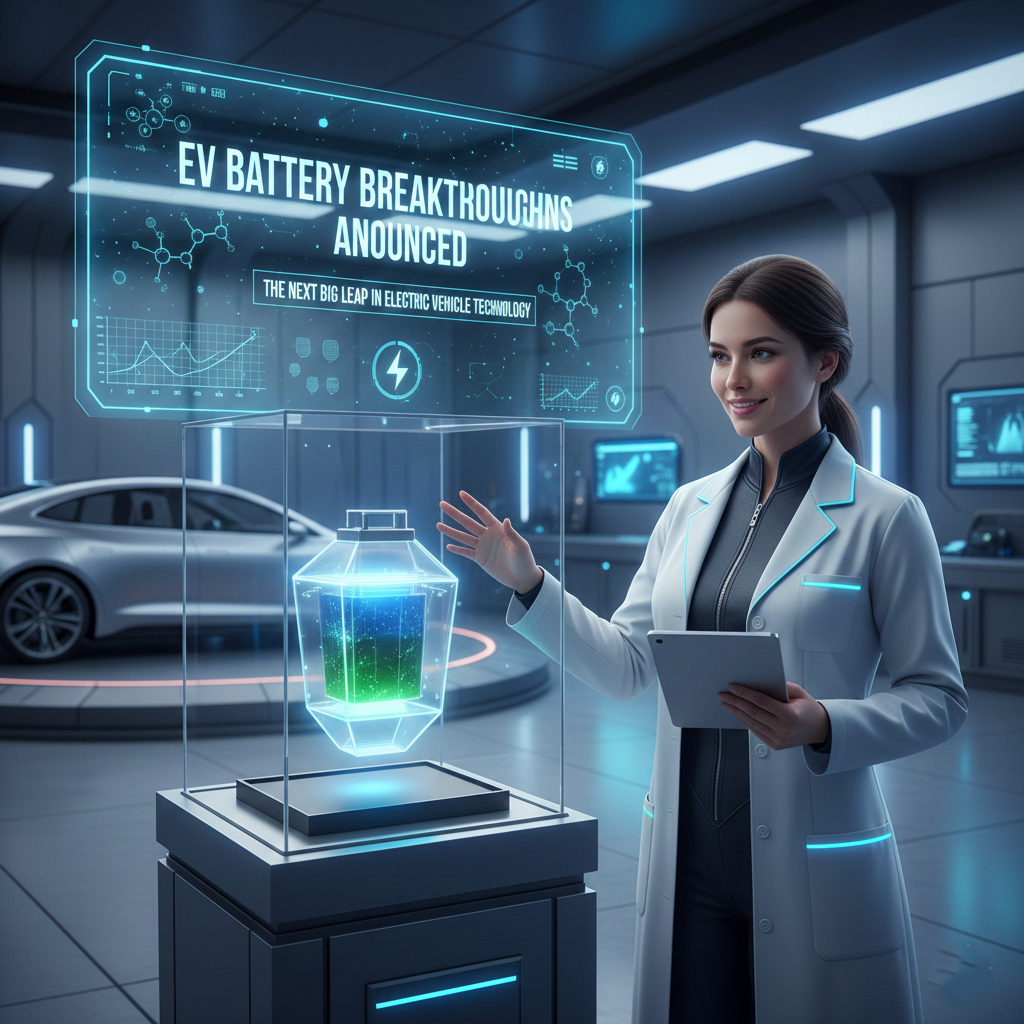
A Turning Point for Electric Vehicle Batteries
EV battery breakthroughs announced this year are redefining what electric vehicles can achieve. From ultra-fast charging and extended driving range to safer chemistries and lower costs, battery innovation is accelerating faster than ever. These advancements are not just laboratory experiments—they are production-ready technologies that will shape the next generation of electric cars, buses, trucks, and two-wheelers.
As governments push net-zero targets and consumers demand better performance, EV battery technology has become the backbone of the clean mobility revolution. This article breaks down the latest EV battery breakthroughs, explains how they work, compares new battery types, and explores what they mean for drivers, manufacturers, and the global energy ecosystem.
Why EV Battery Technology Matters More Than Ever
Electric vehicles are only as good as their batteries. Range anxiety, charging time, battery degradation, and cost have historically slowed EV adoption. Recent EV battery breakthroughs directly address these pain points.
Key reasons battery innovation is critical:
- Batteries account for 30–40% of an EV’s total cost
- Charging speed determines real-world usability
- Energy density impacts vehicle range and weight
- Safety and thermal stability affect consumer trust
- Battery lifespan influences resale value and sustainability
With global EV sales crossing new records every year, battery innovation is no longer optional—it is essential.
Major EV Battery Breakthroughs Announced Recently
Solid-State Batteries Move Closer to Mass Production
Solid-state batteries are widely considered the holy grail of EV energy storage. Unlike traditional lithium-ion batteries that use liquid electrolytes, solid-state batteries use solid electrolytes.
Key advantages:
- 2x to 3x higher energy density
- Significantly improved safety (no liquid fire risk)
- Faster charging times
- Longer battery lifespan
Automakers and battery giants have announced pilot production lines with commercial deployment expected within the next few years. This breakthrough could enable EVs with 800–1,000 km range on a single charge.
Ultra-Fast Charging Batteries: Minutes, Not Hours
One of the most exciting EV battery breakthroughs announced is ultra-fast charging capability. New lithium-based chemistries and advanced anode materials allow batteries to charge from 10% to 80% in under 10 minutes.
How this changes EV ownership:
- Charging becomes comparable to refueling a petrol car
- Reduced dependency on home charging
- Greater confidence for long-distance travel
- Higher utilization for fleet and commercial EVs
Advanced thermal management systems and AI-controlled charging algorithms are making fast charging safer and more efficient than ever.
Lithium-Iron Phosphate (LFP) Batteries Get Smarter
LFP batteries are not new, but recent improvements have made them a serious competitor to traditional lithium-ion batteries.
Latest LFP battery advancements:
- Improved energy density
- Better cold-weather performance
- Longer cycle life
- Lower production costs
- Reduced reliance on rare metals like cobalt and nickel
These breakthroughs make LFP batteries ideal for affordable EVs, electric buses, and mass-market vehicles, especially in emerging markets.
Sodium-Ion Batteries: A Low-Cost Game Changer
Sodium-ion battery technology has emerged as a powerful alternative to lithium-based systems. Since sodium is abundant and inexpensive, these batteries could dramatically reduce EV costs.
Benefits of sodium-ion EV batteries:
- Lower raw material costs
- Strong performance in extreme temperatures
- High safety profile
- Reduced supply chain risks
While sodium-ion batteries currently offer lower energy density than lithium-ion, ongoing EV battery breakthroughs are rapidly closing the gap.
Silicon Anode Technology Boosts Range
Traditional graphite anodes are being replaced or enhanced with silicon-based materials. Silicon can store significantly more lithium ions, increasing energy density.
What silicon anodes deliver:
- Up to 20–40% more driving range
- Faster charging capability
- Smaller, lighter battery packs
Recent breakthroughs focus on preventing silicon expansion, which previously caused battery degradation. New nano-structured designs and binders have solved this issue.
Comparison of Next-Generation EV Battery Technologies
| Battery Type | Energy Density | Charging Speed | Cost | Safety | Commercial Readiness |
|---|---|---|---|---|---|
| Lithium-Ion (NMC) | High | Fast | Medium-High | Moderate | Widely Available |
| Solid-State | Very High | Very Fast | High (for now) | Excellent | Pilot Stage |
| LFP | Medium | Moderate | Low | Very High | Mass Production |
| Sodium-Ion | Medium-Low | Moderate | Very Low | Very High | Early Commercial |
| Silicon-Anode Li-ion | High+ | Very Fast | Medium | High | Scaling Up |
How EV Battery Breakthroughs Improve Real-World Driving
Longer Driving Range Without Bigger Batteries
New chemistries and higher energy density allow manufacturers to increase range without increasing battery size. This means:
- Lighter vehicles
- Better efficiency
- Improved handling
- Lower material usage
Safer Batteries with Lower Fire Risk
Advanced separators, solid electrolytes, and AI monitoring systems significantly reduce thermal runaway risks. Safety improvements are critical for consumer confidence and regulatory approval.
Slower Degradation and Longer Battery Life
Modern EV batteries are now designed to last 10–15 years or more. Some new batteries retain over 90% capacity after thousands of charge cycles.
Impact on EV Prices and Affordability
EV battery breakthroughs announced in recent years are driving costs down steadily.
Key cost reduction drivers:
- Simplified battery chemistries
- Localized manufacturing
- Reduced reliance on scarce minerals
- Improved recycling technologies
Experts expect EV prices to reach parity with internal combustion vehicles in many markets sooner than previously predicted.
Sustainability and Battery Recycling Innovations
Battery innovation is not just about performance—it is also about sustainability.
Recent recycling breakthroughs include:
- Closed-loop battery recycling systems
- Recovery rates above 90% for lithium, nickel, and cobalt
- Lower energy recycling processes
- Second-life battery applications for energy storage
These developments reduce environmental impact and strengthen the circular economy.
Role of AI and Software in EV Battery Management
Artificial intelligence is playing a major role in maximizing battery performance.
AI-powered battery management systems:
- Predict degradation patterns
- Optimize charging speed in real time
- Improve thermal control
- Extend overall battery lifespan
Smart software is now as important as battery chemistry itself.
What This Means for EV Buyers
If you are planning to buy an electric vehicle, these EV battery breakthroughs mean:
- Shorter charging stops
- More affordable EV options
- Better resale value
- Improved safety
- Lower long-term ownership costs
Future EVs will feel less like an alternative and more like a superior choice.
Industry and Market Outlook
The global EV battery market is expected to grow exponentially, driven by:
- Government incentives
- Climate commitments
- Infrastructure expansion
- Rapid innovation cycles
Manufacturers that lead in battery technology will dominate the next decade of mobility.
Frequently Asked Questions About EV Battery Breakthroughs
What is the biggest EV battery breakthrough right now?
Solid-state batteries are considered the most transformative due to their high energy density, safety, and fast charging potential.
Will EV batteries become cheaper in the future?
Yes. Advances in chemistry, manufacturing scale, and alternative materials like sodium are significantly reducing costs.
How long will next-generation EV batteries last?
Most new batteries are designed to last 10–15 years or over 300,000 kilometers with minimal degradation.
Are new EV batteries safer than older ones?
Absolutely. Improved materials, thermal management, and solid electrolytes greatly enhance safety.
When will solid-state batteries be available in EVs?
Limited commercial models are expected within the next few years, with mass adoption later in the decade.
Challenges That Still Remain
Despite major EV battery breakthroughs announced, some challenges persist:
- Scaling solid-state battery production
- Securing raw materials ethically
- Building fast-charging infrastructure
- Standardizing battery recycling globally
However, innovation is progressing rapidly on all fronts.
Conclusion: The Future of EVs Is Battery-Driven
EV battery breakthroughs announced recently mark a defining moment in automotive history. Faster charging, longer range, safer chemistries, and lower costs are transforming electric vehicles from early adopters’ choices into mainstream mobility solutions.
As battery technology continues to evolve, electric vehicles will become more accessible, reliable, and sustainable for everyone. The road ahead is electric—and it is powered by smarter, stronger, and more efficient batteries.
