

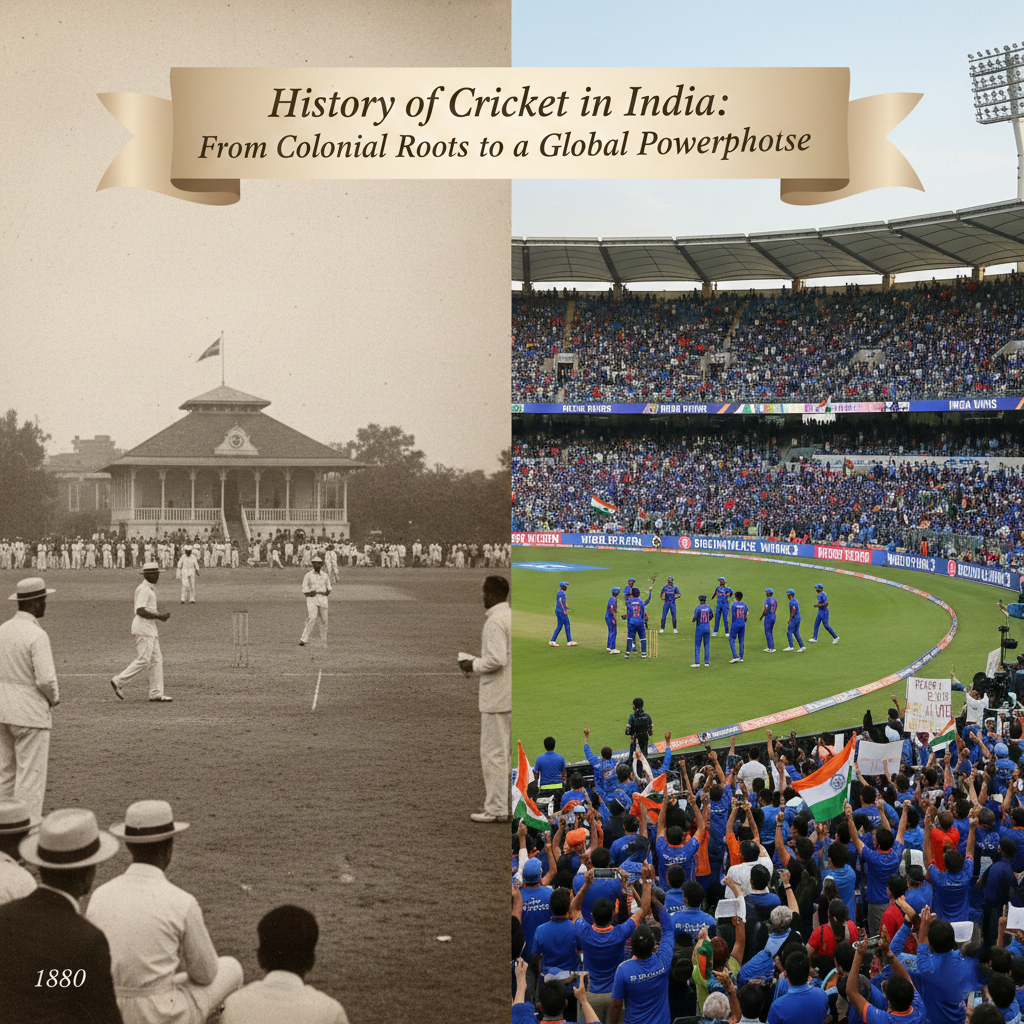
The Journey of Cricket in India
Cricket in India is not just a sport—it is an emotion, a unifying force, and a cultural phenomenon. From dusty maidans in small towns to world-class stadiums packed with roaring fans, cricket has shaped India’s sporting identity like no other game. Today, India stands as one of the most dominant forces in world cricket, but this journey was long, complex, and deeply tied to the country’s social and political history.
The history of cricket in India dates back more than 300 years and mirrors India’s transformation from a British colony to an independent nation with global sporting influence. This article explores that journey in detail—covering key milestones, legendary players, iconic victories, and the rise of India as a cricketing superpower.
Early Beginnings of Cricket in India
Arrival of Cricket with British Rule
Cricket was introduced to India by British sailors and traders in the early 18th century. The first recorded cricket match in India was played in 1721, making India one of the earliest countries outside England to embrace the sport.
Key early developments:
- Introduced by British East India Company officials
- Played initially by British soldiers and elites
- Gradually adopted by Indian communities
At first, cricket remained an exclusive colonial pastime. However, Indian communities soon began to see the game as an opportunity to engage with the ruling class and build social unity.
Role of the Parsi Community in Indian Cricket
India’s First Cricket Pioneers
The Parsi community of Bombay (Mumbai) played a crucial role in popularizing cricket among Indians. By the mid-1800s, Parsis had formed their own cricket clubs and competed against British teams.
Major milestones:
- 1848: First Indian cricket club founded by Parsis
- 1886: Parsis toured England, the first Indian team to do so
- Laid the foundation for Indian participation in organized cricket
Their efforts broke racial barriers and inspired other communities to take up the sport.
Formation of Domestic Cricket Structure
Birth of Competitive Cricket in India
As cricket gained popularity, structured competitions began to emerge. One of the most significant developments was the Bombay Quadrangular, which later became the Pentangular, featuring teams based on religious communities.
Later reforms shifted focus from community-based teams to regional representation.
Ranji Trophy: Backbone of Indian Cricket
In 1934, the Ranji Trophy was introduced and remains India’s premier domestic first-class tournament.
Why the Ranji Trophy matters:
- Identifies and nurtures grassroots talent
- Produces future international players
- Strengthens India’s cricketing depth
Many legends of Indian cricket began their journey in domestic tournaments.
India’s Entry into International Cricket
India’s First Test Match
India played its first Test match in 1932 against England at Lord’s, becoming the sixth Test-playing nation.
Key facts:
- Captain: C.K. Nayudu
- Opponent: England
- Result: Loss, but a proud beginning
Although India struggled initially, this marked the start of its international cricket journey.
Post-Independence Era and Early Challenges
Finding Identity After 1947
After gaining independence in 1947, India began building its own cricketing identity. The team faced challenges such as:
- Limited infrastructure
- Inexperienced administration
- Strong overseas opponents
Despite these hurdles, India recorded its first Test win in 1952 against England.
The Rise of Indian Cricket Legends
1960s–1970s: Building Confidence
The 1960s and 70s saw India becoming competitive, especially at home. Spin bowling became India’s strength.
Legendary players of this era:
- Sunil Gavaskar – first batter to score 10,000 Test runs
- Bishan Singh Bedi – master of spin bowling
- Kapil Dev – India’s greatest all-rounder
1983 World Cup: A Turning Point
India’s Greatest Sporting Upset
The 1983 Cricket World Cup victory changed Indian cricket forever. Under Kapil Dev’s captaincy, India defeated the mighty West Indies at Lord’s.
Impact of the 1983 win:
- Cricket became a national obsession
- Massive growth in sponsorship and media coverage
- Inspired a new generation of cricketers
This victory marked India’s arrival as a global cricketing force.
1990s: Commercialization and the Sachin Era
Sachin Tendulkar and the Cricket Boom
The 1990s transformed Indian cricket both on and off the field. Satellite television, sponsorships, and advertising changed the economics of the game.
Key highlights:
- Sachin Tendulkar became a global icon
- Increased financial stability for players
- Rise of professional cricket culture
Sachin’s records and consistency gave Indian fans hope during difficult transitions.
BCCI and India’s Growing Influence
Power Shift in World Cricket
The Board of Control for Cricket in India (BCCI) emerged as the most powerful cricket board globally.
Reasons behind BCCI’s dominance:
- Huge fan base
- Strong commercial revenue
- Successful domestic leagues
India’s influence reshaped international cricket scheduling and broadcasting.
2000s: New Leadership and Global Success
Dravid, Ganguly, and Dhoni Era
The early 2000s marked a cultural shift in Indian cricket.
Key leaders:
- Sourav Ganguly: Built aggressive, fearless teams
- Rahul Dravid: Stability and technical excellence
- MS Dhoni: Calm leadership and global success
Major achievements:
- 2007 T20 World Cup win
- 2011 ODI World Cup victory
- Consistent overseas performances
Indian Premier League (IPL): Game Changer
Revolutionizing World Cricket
Launched in 2008, the Indian Premier League (IPL) transformed cricket forever.
Why IPL is revolutionary:
- Mix of entertainment and elite sport
- Platform for young Indian talent
- Financial growth for global cricket
IPL made India the economic engine of world cricket.
Modern Indian Cricket: Dominance and Depth
India as a Cricket Superpower
Today, India boasts one of the strongest cricket systems in the world.
Current strengths:
- World-class fast bowlers
- Technically sound batters
- Strong bench strength
- Advanced sports science
India consistently ranks among the top teams across all formats.
Comparison: Early Cricket vs Modern Cricket in India
| Aspect | Early Era | Modern Era |
|---|---|---|
| Infrastructure | Limited | World-class |
| Player Earnings | Minimal | Extremely high |
| Global Influence | Low | Very high |
| Technology | None | Advanced analytics |
Social and Cultural Impact of Cricket in India
Cricket influences Indian society in many ways:
- National unity across regions
- Career opportunities for youth
- Global recognition for Indian talent
- Soft power on the world stage
It goes beyond sport and reflects India’s aspirations.
FAQs: History of Cricket in India
When was cricket introduced in India?
Cricket was introduced in India in the early 1700s by British sailors and traders.
Who played the first Test match for India?
India played its first Test match in 1932 against England at Lord’s.
Why is the 1983 World Cup important?
It transformed cricket into India’s most popular sport and boosted national confidence.
Who is called the God of Cricket?
Sachin Tendulkar is popularly known as the God of Cricket.
How did IPL change Indian cricket?
IPL revolutionized player earnings, global viewership, and talent development.
Conclusion: Cricket as India’s Sporting Soul
The history of cricket in India is a story of resilience, passion, and transformation. From colonial beginnings to global dominance, Indian cricket reflects the country’s journey toward confidence and excellence. With a strong domestic structure, passionate fans, and visionary leadership, the future of Indian cricket looks brighter than ever.
👉 If you love cricket history, share this article and explore more in-depth sports stories on our website. Stay connected, stay inspired!
