

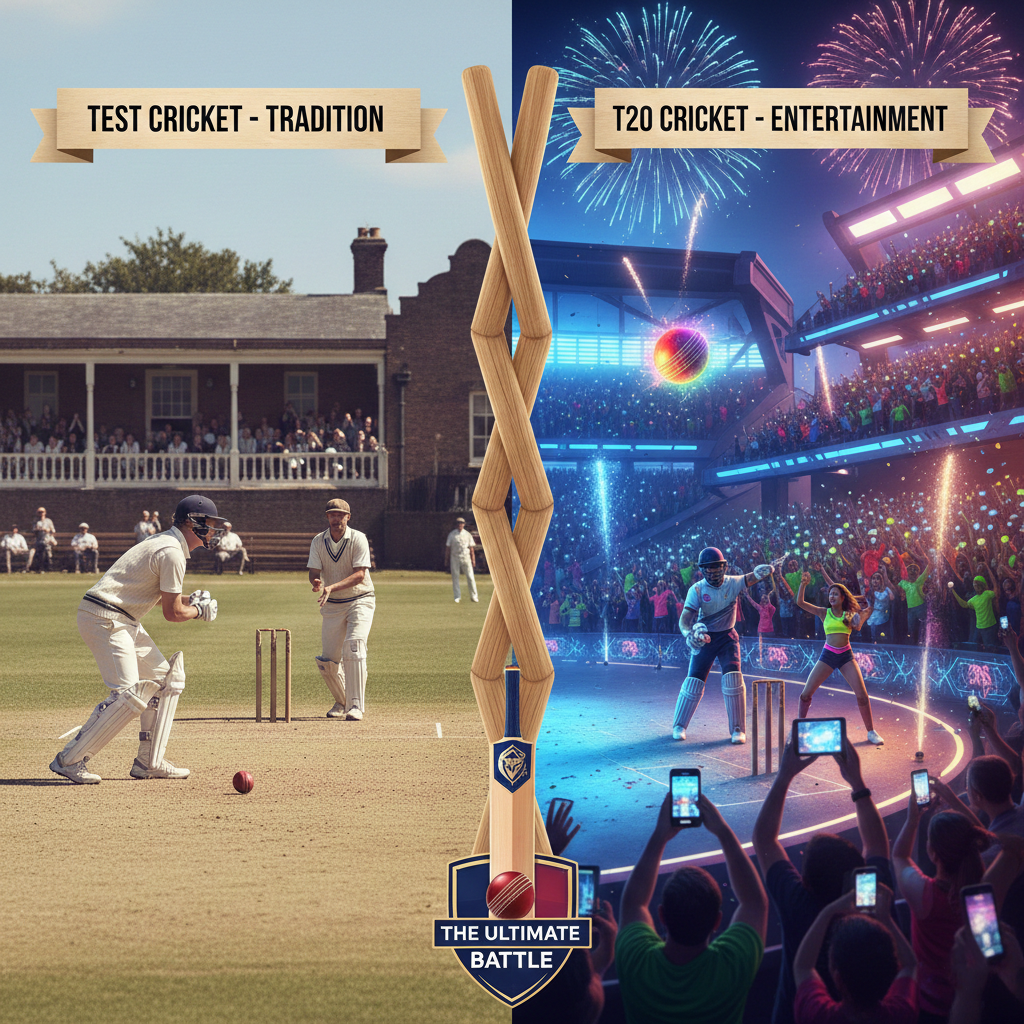
Two Formats, One Soul of Cricket
Cricket is not just a sport; it’s an emotion shared by billions. Yet, this single game wears two very different faces today — Test Cricket and T20 Cricket. One represents patience, technique, and tradition, while the other thrives on speed, power, and instant entertainment.
The debate around Test Cricket vs T20 Cricket is more relevant than ever. Fans, players, and cricket boards often find themselves divided: should cricket preserve its five-day classical format, or embrace the fast-paced T20 era that dominates modern sports consumption?
This article offers a complete, human-written, SEO-optimized comparison of Test Cricket and T20 Cricket — covering rules, skills, strategies, popularity, revenue, player mindset, and the future of the game. Whether you’re a hardcore purist or a modern cricket fan, this guide will give you real insight, not fluff.
Understanding Test Cricket: The Purest Form of the Game
What Is Test Cricket?
Test Cricket is the oldest and longest format of cricket, played over five days between two international teams. Each team plays two innings, with no restriction on overs.
Introduced in 1877, Test cricket is considered the ultimate test of a cricketer’s technique, temperament, fitness, and mental strength.
Key Characteristics of Test Cricket
- Played over 5 days
- Unlimited overs
- Red ball and white clothing
- Matches can end in a draw
- Focus on technique, patience, and strategy
Why Test Cricket Is Called the “Ultimate Test”
Test cricket challenges every aspect of a player’s ability:
- Batters must survive swing, seam, and spin for hours
- Bowlers must maintain accuracy and stamina over long spells
- Captains must plan sessions, not overs
- Fielders must stay sharp for 90 overs a day
Legends like Sachin Tendulkar, Rahul Dravid, Jacques Kallis, and Ricky Ponting built their legacy primarily on Test cricket performances.
Understanding T20 Cricket: The Game Changer
What Is T20 Cricket?
T20 Cricket is the shortest and most explosive format, where each team plays 20 overs. A match finishes in about 3 hours, making it perfect for modern audiences.
The first official T20 international was played in 2005, and the format exploded globally with leagues like the IPL, BBL, PSL, and The Hundred.
Key Characteristics of T20 Cricket
- 20 overs per team
- White ball, colored jerseys
- Fast-paced, result-oriented
- Heavy focus on power-hitting
- High entertainment value
Why T20 Cricket Became So Popular
- Short attention span–friendly
- High scoring and frequent boundaries
- Ideal for prime-time TV
- Massive commercial value
- Opportunities for young and associate-nation players
T20 has transformed cricket into a global entertainment product, similar to football and basketball.
Test Cricket vs T20 Cricket: Format Comparison Table
| Feature | Test Cricket | T20 Cricket |
|---|---|---|
| Match Duration | Up to 5 days | ~3 hours |
| Overs Limit | Unlimited | 20 per side |
| Ball Used | Red | White |
| Clothing | Whites | Colored |
| Result Type | Win/Loss/Draw | Win/Loss/Tie |
| Skill Focus | Technique, patience | Power, agility |
| Fitness Demand | Endurance | Explosive strength |
| Fan Base | Traditional | Mass & youth |
| Revenue | Moderate | Very high |
Batting Skills: Technique vs Power
Batting in Test Cricket
Test batting is about survival and precision. A good Test batter:
- Leaves the ball well
- Plays close to the body
- Builds innings slowly
- Handles different conditions
Scoring a century in Test cricket is often considered more valuable than any other format.
Batting in T20 Cricket
T20 batting is aggressive and fearless:
- Innovative shots (reverse sweep, scoop)
- High strike rate is crucial
- Risk-taking is encouraged
- Adaptation to pressure is key
Players like AB de Villiers, Glenn Maxwell, and Suryakumar Yadav have redefined modern batting.
Bowling Styles: Discipline vs Innovation
Bowling in Test Cricket
Test bowlers focus on:
- Line and length
- Swing, seam, and spin
- Setting up batters over spells
- Exploiting pitch deterioration
Great Test bowlers win matches through patience and planning.
Bowling in T20 Cricket
T20 bowlers must survive brutal hitting:
- Variations are essential
- Yorkers, slower balls, cutters
- Smart field placements
- Mental toughness under pressure
Economy rate matters more than wickets in many situations.
Fielding Standards: Evolution Through T20
One of the biggest impacts of T20 cricket is elite fielding standards.
- Faster reflexes
- Athletic dives
- Boundary-saving efforts
- Direct-hit run-outs
Modern cricketers are far fitter and sharper, benefiting all formats — including Test cricket.
Captaincy & Strategy: Long Chess Match vs Rapid Decisions
Test Match Captaincy
- Session-based planning
- Rotating bowlers intelligently
- Setting traps for batters
- Managing player fatigue
T20 Captaincy
- Ball-by-ball decisions
- Constant field changes
- Match-ups based on data
- Handling pressure moments
Both formats demand intelligence, but in very different ways.
Fan Experience and Popularity
Why Fans Love T20 Cricket
- Short matches
- High entertainment
- Festival-like atmosphere
- Easy to follow for new fans
T20 leagues attract millions of global viewers and massive sponsorships.
Why Test Cricket Still Matters
- Emotional depth
- Narrative over days
- Historical importance
- True cricketing skill showcase
Iconic Test matches are remembered for decades.
Revenue, Sponsorship & Cricket Economy
T20 cricket has changed cricket financially:
- IPL alone generates billions
- Higher player salaries
- Franchise-based earnings
- More global exposure
However, Test cricket maintains prestige and national pride, especially in traditional cricketing nations.
Impact on Players’ Careers
Test Specialists
- Longer careers
- Respect and legacy
- Strong technical base
T20 Specialists
- Faster recognition
- Higher earnings
- Shorter career span in some cases
Many modern players aim to balance all formats, but workload management is a growing challenge.
The Role of Technology and Data
T20 cricket heavily relies on:
- Analytics
- Match-up data
- Strike-rate projections
- Bowling plans based on statistics
Test cricket also uses technology, but instincts still play a larger role.
The Future of Cricket: Can Both Coexist?
The future of cricket lies in balance.
- T20 brings money and new fans
- Test cricket preserves the soul of the game
- Day-night Tests are reviving interest
- World Test Championship adds context
Cricket doesn’t need to choose one format — it needs all of them.
Frequently Asked Questions (FAQs)
Is Test Cricket better than T20 Cricket?
It depends on perspective. Test cricket tests skill and patience, while T20 focuses on entertainment and speed. Both are valuable.
Which format is more popular globally?
T20 cricket is more popular due to its shorter duration and high entertainment value.
Do T20 players struggle in Test cricket?
Some do, but many successful Test players also excel in T20 with proper technique and mindset.
Will Test cricket disappear in the future?
Highly unlikely. While T20 dominates commercially, Test cricket remains essential for the sport’s identity.
Which format is best for beginners?
T20 cricket is easier to understand and more engaging for new fans.
Conclusion: Tradition vs Transformation — A Healthy Rivalry
The debate of Test Cricket vs T20 Cricket is not about superiority; it’s about diversity. Test cricket teaches discipline, resilience, and respect for the game. T20 cricket brings excitement, innovation, and global growth.
Together, they create a complete cricketing ecosystem — one rooted in history and driven by the future.
If you love cricket, you don’t have to choose sides. Celebrate both formats, because each one keeps the game alive in its own powerful way.
👉 Enjoyed this deep cricket analysis? Share it with fellow cricket lovers and stay tuned for more expert sports insights. 🏏
