

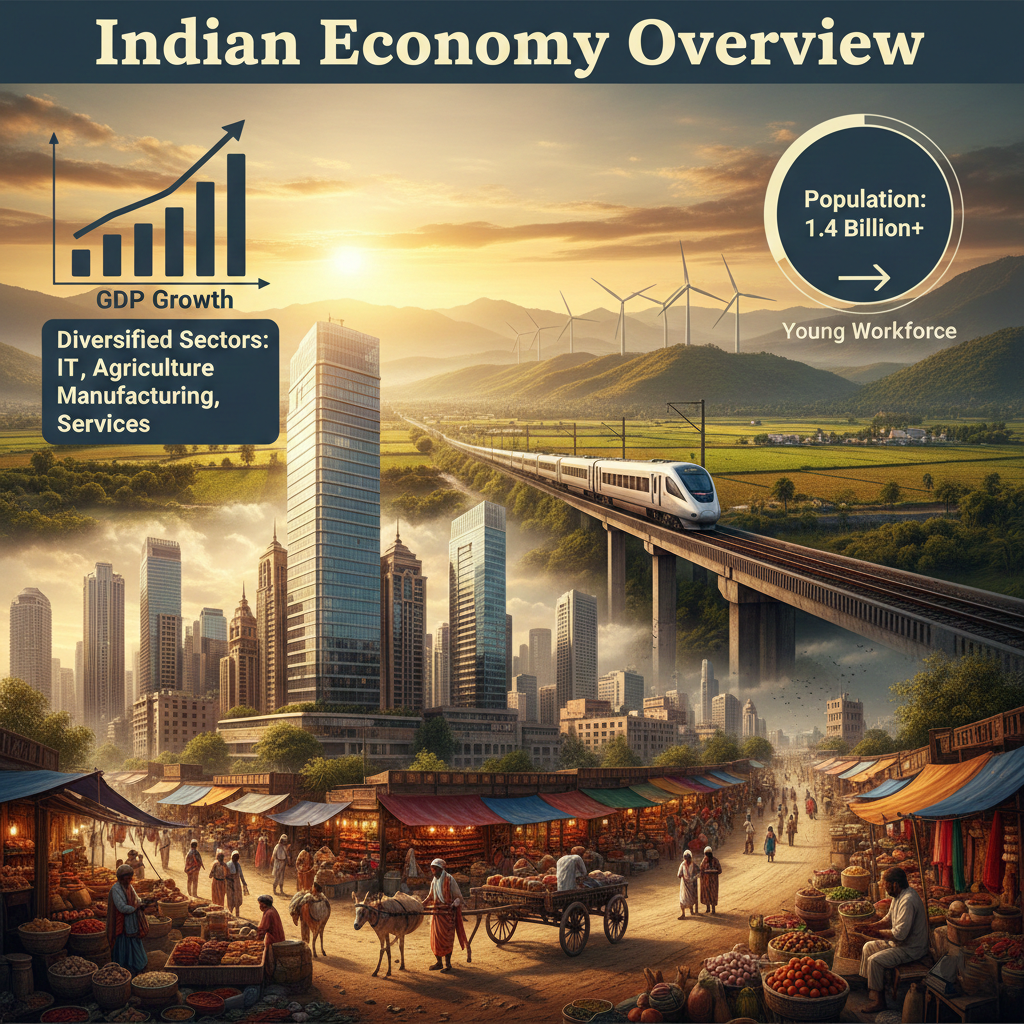
The Indian economy is one of the fastest-growing major economies in the world and a key driver of global growth. From a strong domestic market to rapid digital transformation, India has built a resilient economic framework that continues to evolve despite global uncertainties.
With a population of over 1.4 billion, a young workforce, and rising innovation, India is transitioning from a developing economy to a global economic powerhouse. This Indian economy overview explains how the country earns, spends, grows, and plans for the future—in a clear, human-friendly, and practical way.
Whether you are a student, investor, entrepreneur, policymaker, or simply curious, this guide will help you understand the structure, performance, strengths, and challenges of the Indian economy.
Understanding the Indian Economy
The Indian economy is classified as a mixed economy, combining private enterprise with government regulation and public sector involvement.
Key Characteristics of the Indian Economy
- Mixed economic system
- Large domestic consumption base
- Strong services sector
- Rapid digital and infrastructure growth
- Expanding manufacturing capacity
- Growing global trade presence
India is currently the 5th largest economy in the world by nominal GDP and ranks 3rd by purchasing power parity (PPP).
India’s GDP Growth and Economic Performance
GDP Size and Growth Rate
India’s Gross Domestic Product (GDP) reflects the total value of goods and services produced within the country.
| Indicator | Value (Approx.) |
|---|---|
| Nominal GDP | $3.7+ trillion |
| GDP Growth Rate | 6–7% annually |
| GDP Rank (Nominal) | 5th globally |
| GDP Rank (PPP) | 3rd globally |
India’s consistent growth is driven by:
- Domestic consumption
- Government capital expenditure
- Digital services
- Export diversification
Why India’s Growth Is Considered Resilient
- Strong internal demand reduces dependence on exports
- Banking and financial reforms improved stability
- Controlled inflation compared to global peers
- Strategic policy support during global downturns
Sector-Wise Contribution to the Indian Economy
Agriculture Sector: Backbone of Rural India
Although agriculture contributes a smaller share to GDP, it remains crucial for employment and food security.
Key facts:
- Employs nearly 45% of the workforce
- Contributes around 15–17% to GDP
- Major crops include rice, wheat, sugarcane, pulses, and cotton
Challenges in agriculture:
- Dependence on monsoon
- Low productivity in small landholdings
- Need for better storage and logistics
Government focus areas:
- Farmer income doubling initiatives
- Crop insurance schemes
- Digital agriculture platforms
Industrial Sector: Manufacturing and Infrastructure Growth
The industrial sector plays a vital role in job creation and exports.
Major industries include:
- Manufacturing
- Construction
- Mining
- Power and energy
- Automobiles and electronics
Make in India and Production-Linked Incentive (PLI) schemes aim to make India a global manufacturing hub.
Growth drivers:
- Infrastructure investment
- Ease of doing business reforms
- Rising foreign direct investment (FDI)
Services Sector: The Growth Engine
The services sector is the largest contributor to the Indian economy.
Key service industries:
- Information Technology (IT)
- Banking and financial services
- Telecommunications
- Tourism and hospitality
- Healthcare and education
Why services dominate India’s economy:
- High-value exports (IT and software services)
- Skilled English-speaking workforce
- Rapid digital adoption
The IT sector alone contributes billions in export earnings annually.
Role of Government Policies and Economic Reforms
Major Economic Reforms in India
India’s economic transformation is backed by long-term reforms.
Notable reforms include:
- Goods and Services Tax (GST)
- Insolvency and Bankruptcy Code (IBC)
- Corporate tax rationalization
- Digital payment infrastructure
- Labor law consolidation
These reforms aim to improve transparency, efficiency, and investor confidence.
Digital Economy and Financial Inclusion
India has built one of the world’s strongest digital public infrastructures.
Key achievements:
- Unified Payments Interface (UPI)
- Aadhaar-based identity system
- Direct Benefit Transfers (DBT)
- Expansion of digital banking
This digital foundation has reduced corruption, improved service delivery, and boosted financial inclusion.
Foreign Trade and Global Position
Exports and Imports
India trades with over 190 countries.
Major exports:
- Petroleum products
- Pharmaceuticals
- Software services
- Textiles
- Engineering goods
Major imports:
- Crude oil
- Electronics
- Gold
- Machinery
India is actively reducing import dependency through local manufacturing and innovation.
Foreign Direct Investment (FDI)
India consistently ranks among the top FDI destinations globally.
Reasons investors choose India:
- Large consumer market
- Political and economic stability
- Startup ecosystem growth
- Pro-business reforms
Employment, Demographics, and Workforce
India has one of the youngest populations in the world.
Demographic Advantage
- Over 65% of population under 35 years
- Large skilled and semi-skilled workforce
- Growing startup and gig economy
Employment Challenges
- Informal sector dominance
- Skill mismatch in emerging industries
- Need for large-scale job creation
Solutions underway:
- Skill India Mission
- Startup India
- Industrial corridors
Inflation, Fiscal Deficit, and Monetary Policy
Inflation Management
The Reserve Bank of India (RBI) plays a key role in maintaining price stability.
Key tools used by RBI:
- Repo rate adjustments
- Liquidity management
- Regulatory supervision
India has managed inflation better than many global economies despite external shocks.
Fiscal Deficit and Public Spending
Government spending focuses on:
- Infrastructure development
- Social welfare programs
- Healthcare and education
A balanced fiscal approach supports growth while maintaining macroeconomic stability.
Challenges Facing the Indian Economy
Despite strong fundamentals, challenges remain.
Key economic challenges:
- Income inequality
- Urban-rural divide
- Climate change impact
- Global economic volatility
- Infrastructure gaps in some regions
Addressing these issues requires coordinated policy action and private sector participation.
Future Outlook of the Indian Economy
Why India’s Economic Future Looks Strong
- Growing middle class consumption
- Rapid urbanization
- Green energy transition
- Manufacturing expansion
- Technological innovation
Experts project India to become the third-largest economy by the early 2030s if current growth trends continue.
Emerging Growth Areas
- Renewable energy
- Artificial intelligence and deep tech
- Electric vehicles
- Semiconductor manufacturing
- Healthcare and biotechnology
Frequently Asked Questions (FAQs)
What type of economy does India have?
India has a mixed economy where private businesses operate alongside government-controlled sectors, balancing growth with social welfare.
Which sector contributes the most to the Indian economy?
The services sector contributes the highest share to India’s GDP, followed by industry and agriculture.
Why is India considered a fast-growing economy?
Strong domestic demand, a young workforce, digital transformation, and consistent reforms make India one of the fastest-growing major economies.
What are the biggest challenges for the Indian economy?
Key challenges include unemployment, income inequality, climate risks, and global economic uncertainties.
What is the future of the Indian economy?
India’s future is positive, with strong growth prospects driven by technology, infrastructure investment, manufacturing, and global integration.
Conclusion: The Road Ahead for India
The Indian economy stands at a crucial turning point. Backed by strong fundamentals, policy reforms, and a dynamic population, India is shaping a future defined by sustainable growth and global leadership.
While challenges remain, the country’s ability to adapt, innovate, and scale solutions sets it apart. For businesses, investors, students, and policymakers, understanding the Indian economy is key to unlocking long-term opportunities.
👉 Stay informed, invest wisely, and keep tracking India’s economic journey—because the next decade belongs to India.
