

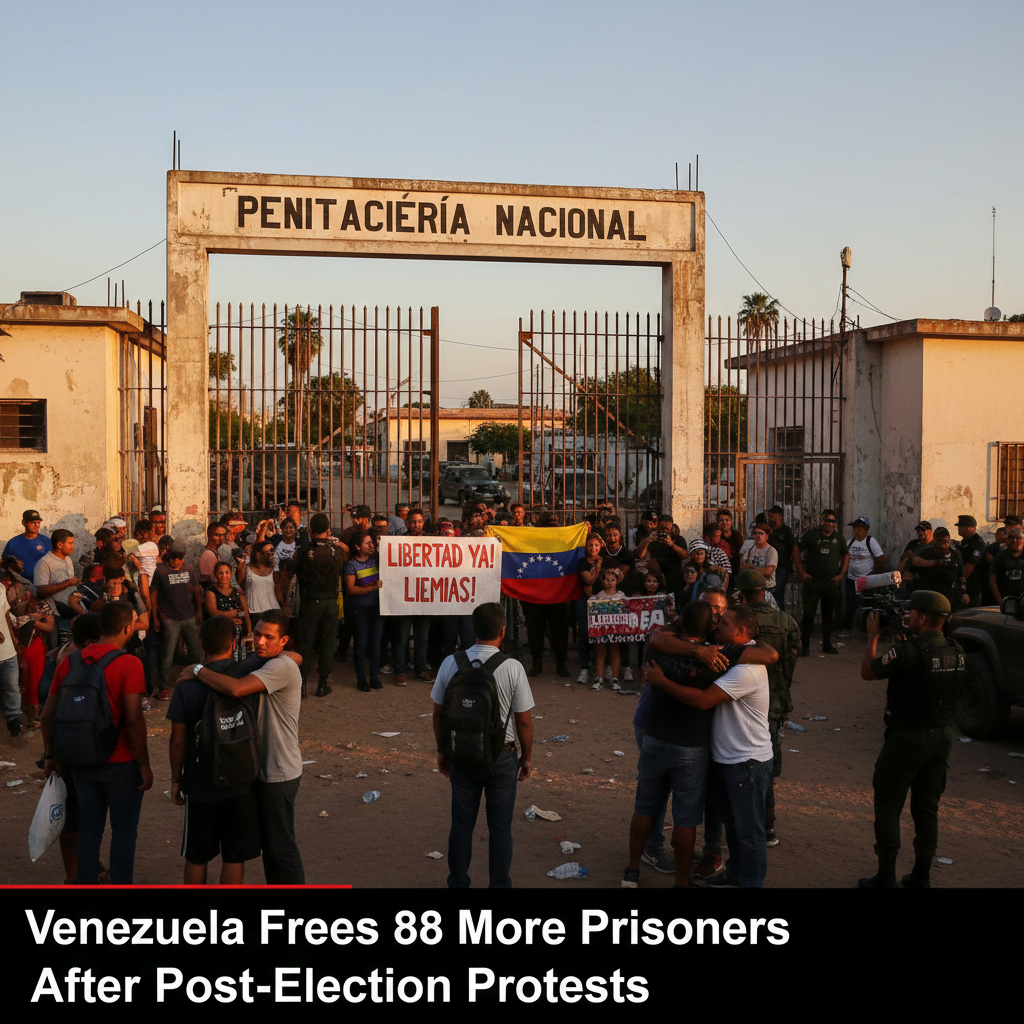
In a major development linked to Venezuela’s political tensions, Venezuela has freed 88 more prisoners detained after the post-election protests that followed the controversial July 2024 presidential vote. This latest release marks a second large group freed within just two weeks, drawing renewed focus on human rights, justice, and the influence of global diplomatic pressures. While Caracas frames the move as part of legal review and reconciliation, critics say political prisoners still remain behind bars.
This article explains the situation in depth, why it’s significant, who’s involved, and what this means for Venezuela’s fragile political landscape and human rights record.
Why Venezuela Is Releasing Prisoners Now
Understanding the timing and context of the release
A Second Wave of Releases: Key Details
- 88 prisoners freed on January 1, 2026, detained for their involvement in protests that followed the disputed July 2024 presidential election.
- This follows 99 detainees released on December 26, 2025, bringing the total to at least 187 freed in two weeks.
- Venezuelan authorities say the releases are part of a comprehensive case review ordered by President Nicolás Maduro.
The Venezuelan Government’s Position
The government has repeatedly stated that those detained were charged not as “political prisoners,” but for “crimes committed during violent actions by extremist groups” connected to the protests. Maduro’s administration claims the decision to free people reflects justice, peace, and a return to civil dialogue.
Pressure From the United States and International Community
International pressure, especially from the United States under President Donald Trump’s administration, has been a driving factor behind recent political developments. The U.S. has increased diplomatic and military pressure on Caracas, urging respect for democratic norms and calling for the release of detainees.
Who Were the Detainees?
Profile of Those Arrested
Most detainees released were ordinary citizens, protest participants, activists, and in some cases journalists. Many were held at Tocorón prison in Aragua state, one of Venezuela’s most notorious detention facilities.
Studies and reports by rights organizations found that both adults and minors were arrested in the months following the July 2024 election, often without formal arrest warrants.
Estimated Number Still Detained
Despite recent releases, human rights groups estimate that hundreds more political prisoners remain in custody — possibly as many as 900 or more — according to multiple monitoring efforts by NGOs.
Table: Detainees Released vs. Estimated Still in Custody
| Category | Estimate |
|---|---|
| Released Dec 26–Jan 1 | ~187+ |
| Confirmed by NGOs | ~55+ verified released |
| Estimated still jailed | ~900+ |
| Arrests recorded post-election | ~2,400+ |
| Source: Multiple human rights reports & Reuters Investing.com+1 |
What Sparked the Protests and Arrests?
The July 2024 Presidential Election Fallout
The controversy began after President Nicolás Maduro was declared the winner of the July 28, 2024 election, securing a third term. The opposition — backed by independent tallies and observers — claimed the official results were manipulated. This triggered widespread protests across Venezuela.
Government Crackdown: Operation Tun Tun
Authorities initiated what critics termed “Operation Tun Tun,” a door-to-door arrest strategy targeting protesters, activists, and perceived opponents. This approach drew criticism from international human rights observers.
International Human Rights Concerns
Independent reports, including from Human Rights Watch and Foro Penal, documented arbitrary detentions, lack of due process, and in some cases torture or mistreatment, raising serious questions about Venezuela’s compliance with international legal standards.
Impact on Venezuelan Society
This storyline goes beyond prisoner numbers — it reflects deeper issues in Venezuela’s political and human rights climate. Below are key areas affected:
1. Human Rights and Civil Liberties
- Arbitrary detention of protestors has sparked international concern.
- Journalists and media workers were among those charged under harsh anti-terrorism laws.
- Rights groups continue to push for full transparency and legal protections.
2. Political Polarization and Trust
The releases have mixed receptions — while some see them as steps toward reconciliation, others view them as insufficient or symbolic gestures. The deep divide between opposition supporters and the Maduro government persists.
3. Diplomatic Pressures and Sanctions
Venezuela remains under U.S. sanctions and international scrutiny. Recent reports highlight broader geopolitical tensions that influence domestic policy, including military engagements and sanctions enforcement.
Internal Link for Context
Read more on related developments: thenews.zone for comprehensive coverage on Venezuela’s political crisis.
Frequently Asked Questions (FAQs)
Why were these prisoners detained in the first place?
They were arrested following mass protests against the disputed 2024 election results. The government labeled many arrests as related to “violent actions” and “terrorism,” while critics call them arbitrary detentions of political opponents.
Is Venezuela now releasing political prisoners permanently?
Not entirely. Human rights organizations estimate hundreds remain detained, and recent releases are part of a wider review process rather than full amnesty.
What role has the United States played in this situation?
The U.S. has increased military and diplomatic pressure on Maduro’s government, urging respect for democracy and the release of detainees.
Are international bodies involved in monitoring this?
Yes. Organizations such as Human Rights Watch, Foro Penal, and the Inter-American Commission on Human Rights have been active in documenting abuses and advocating for rights protections.
Where can I follow ongoing developments in Venezuela?
For the latest verified updates, including human rights and legal changes, visit trusted international news outlets and dedicated reporting platforms such as thenews.zone
Conclusion
The release of 88 more prisoners in Venezuela is a notable development in a deeply complex political crisis marked by contested elections, human rights concerns, and international pressure. While it represents a positive step toward easing tensions, many questions remain about justice, accountability, and the fate of those still detained.
📢 Stay informed and engaged. For continuous coverage on Venezuela’s political developments and related global news, visit thenews.zone.
External Resources & Further Reading
- Human Rights Watch: Punished for Seeking Change — detailed analysis of post-election abuses.
- Reuters – latest reporting on the 88 prisoner release.
- Wikipedia: Operation Tun Tun and 2024 Venezuelan political crisis context.
