

A Groundbreaking Archaeological Moment Near Taxila
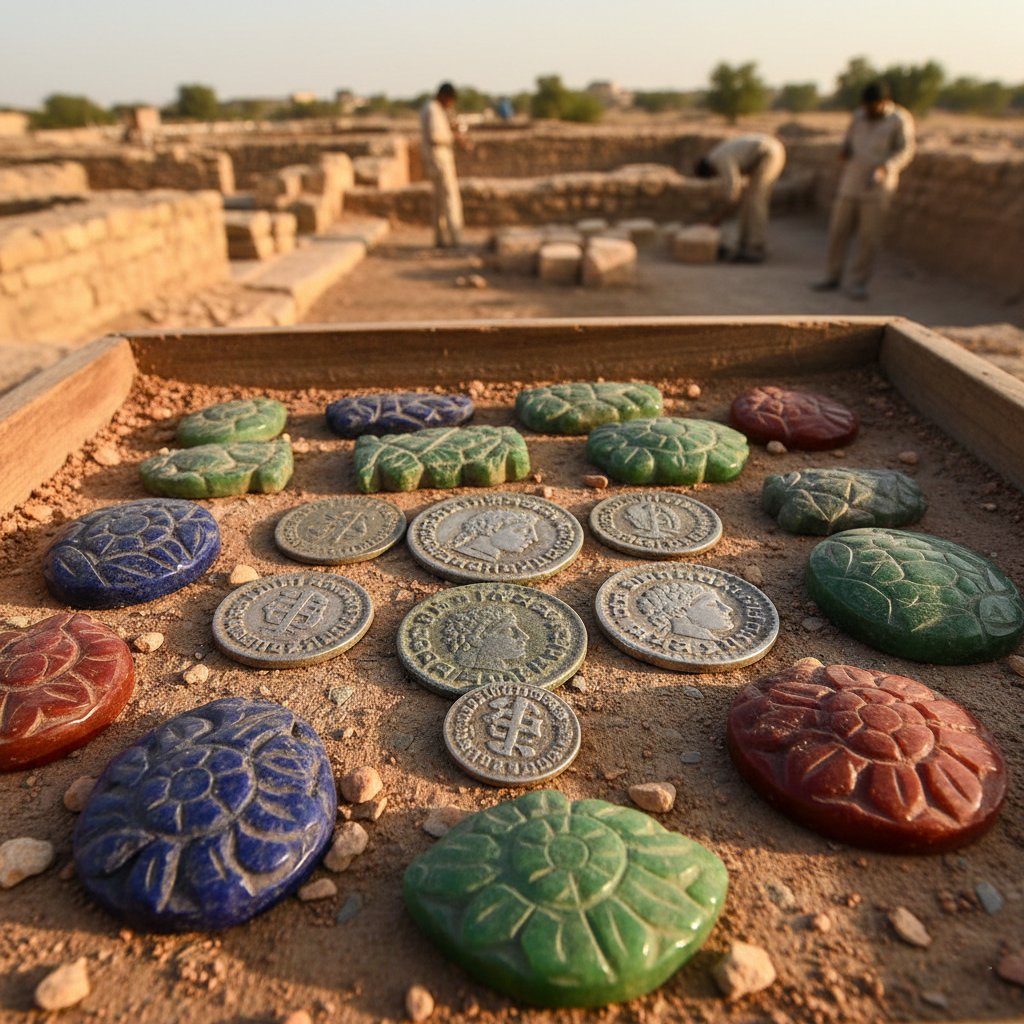
Pakistan archaeologists have once again placed the country in the global spotlight after uncovering rare ancient coins and decorative stones at a UNESCO-listed archaeological site near Taxila. Not only does this discovery add to Pakistan’s already rich cultural legacy, but it also provides historians with fresh physical evidence of ancient trade, craftsmanship, and cultural exchange.
Importantly, Taxila has long been recognized as one of South Asia’s most historically significant regions. Therefore, every new excavation in the area carries enormous academic and cultural weight. This latest find, however, stands out because it connects economic history with artistic traditions in a way rarely seen before.
As a result, scholars believe the discovery could significantly reshape existing narratives surrounding the Gandhara civilization, which once flourished at the crossroads of Asia.
Why Taxila Has Always Been Central to Ancient History
A City That Connected Civilizations
To fully understand the importance of this discovery, one must first understand Taxila’s historical role. Situated near present-day Islamabad, Taxila served as a meeting point for traders, monks, scholars, and empires for centuries.
Moreover, Taxila thrived between 1000 BCE and the 5th century CE, making it one of the longest continuously inhabited cities in the region.
Key reasons why Taxila remains globally important include:
- It functioned as a major Buddhist learning center
- It lay along ancient Silk Road trade routes
- It hosted one of the world’s earliest universities
- It blended Greek, Persian, and South Asian cultures
Consequently, UNESCO declared Taxila a World Heritage Site, recognizing its exceptional universal value.
Rare Ancient Coins: Evidence of Trade and Power
What Sets These Coins Apart
During the excavation, archaeologists uncovered well-preserved ancient coins, many of which differ significantly from previously found specimens. Notably, experts believe these coins date back more than 2,000 years.
Furthermore, initial examinations suggest links to Indo-Greek and Kushan rulers, who governed the region during periods of intense trade and cultural fusion.
Distinct features of the coins include:
- Inscriptions in Greek and Kharosthi scripts
- Symbols associated with early Buddhist beliefs
- Copper and silver alloys rarely seen together
Therefore, these coins are not merely currency; instead, they are historical documents preserved in metal.
Why These Coins Matter Historically
Beyond their rarity, the coins help historians understand:
- Political authority and administrative systems
- Trade relations with Central Asia and beyond
- Economic stability during specific ruling periods
As a result, researchers can now more accurately date settlements and identify previously unknown trade networks.
Decorative Stones Reveal Artistic Brilliance
Craftsmanship Influenced by Multiple Cultures
Alongside the coins, archaeologists also discovered decorative stones featuring intricate carvings. Interestingly, these stones display a combination of local artistic traditions and Hellenistic influences.
Moreover, experts believe these stones were once part of:
- Religious monuments
- Monasteries and stupas
- Residences of elites or scholars
Common design elements include floral patterns, symbolic motifs, and precise geometric shapes, all of which demonstrate advanced craftsmanship.
Understanding Daily Life Through Decorative Art
While coins tell economic stories, decorative stones reveal social and cultural details. For instance, such artifacts indicate:
- Architectural preferences
- Religious symbolism
- Wealth distribution in ancient societies
Consequently, historians gain a more complete picture of everyday life during the Gandhara period.
UNESCO Protection and Its Role in Preservation
Why UNESCO Status Is Crucial
Because the site is UNESCO-listed, it benefits from international protection standards. Therefore, excavation activities follow strict conservation guidelines to prevent damage.
UNESCO status ensures:
- Legal protection against illegal digging
- International conservation support
- Long-term preservation planning
To learn more about how UNESCO protects heritage sites worldwide, visit the UNESCO World Heritage Centre.
Modern Archaeology Meets Ancient History
Advanced Excavation Techniques Used
Unlike earlier digs, this excavation employed modern archaeological methods, ensuring precision and safety. For example, the team used:
- Ground-penetrating radar (GPR)
- Stratigraphic excavation techniques
- Digital mapping and 3D recording
- Planned carbon dating for accuracy
As a result, archaeologists were able to uncover artifacts without disturbing surrounding structures.
How This Discovery Compares to Previous Finds in Taxila
| Category | Earlier Discoveries | Recent Discovery |
|---|---|---|
| Primary Focus | Religious statues | Coins & decorative stones |
| Trade Evidence | Limited | Strong and verifiable |
| Cultural Insight | Mostly spiritual | Economic and artistic |
| Dating Accuracy | Approximate | More precise |
Clearly, this new discovery expands historical understanding far beyond religion alone.
Why the Discovery Matters Globally
International Academic Interest Grows
Not surprisingly, scholars around the world are closely monitoring this discovery. After all, it offers rare physical evidence supporting historical texts.
Additionally, it highlights:
- Early globalization through trade
- Cultural exchange across continents
- The sophistication of ancient South Asian societies
As a result, international research collaborations are expected in the coming months.
Economic and Tourism Impact on the Region
A New Chapter for Cultural Tourism
Meanwhile, the discovery is expected to boost heritage tourism in Pakistan. Since Taxila already attracts history enthusiasts, this new find could further increase visitor numbers.
Potential benefits include:
- Growth in local tourism revenue
- Job creation for nearby communities
- Increased global awareness of Pakistan’s heritage
Studies suggest heritage tourism can increase regional income by 20–30% when properly promoted.
For continued coverage on archaeology and heritage developments, visit thenews.zone (internal reference).
Preservation Challenges Still Remain
Obstacles Facing Archaeological Sites
However, despite positive developments, several challenges persist:
- Limited excavation funding
- Illegal artifact smuggling
- Environmental wear and tear
- Urban development pressures
Therefore, experts stress the need for stronger policies and public awareness to protect such sites.
What Happens Next with the Artifacts
Research, Conservation, and Public Display
Following the discovery, authorities plan to:
- Conduct laboratory testing
- Preserve artifacts under controlled conditions
- Display selected items in national museums
- Publish findings in academic journals
Consequently, both researchers and the public will benefit from these efforts.
Frequently Asked Questions (FAQs)
What exactly was discovered near Taxila?
Rare ancient coins and decorative stones dating back over 2,000 years were found.
Why is Taxila considered globally important?
Because it represents a unique blend of learning, culture, and trade recognized by UNESCO.
Which civilization do the artifacts belong to?
Primarily the Gandhara civilization, with Indo-Greek and Kushan influences.
Will the public be able to see the artifacts?
Yes, after conservation, selected artifacts will be displayed in museums.
Where can I follow verified heritage news?
For reliable updates, visit thenews.zone.
Conclusion: A Discovery That Strengthens Pakistan’s Historical Legacy
Ultimately, the discovery of rare coins and decorative stones at a UNESCO-listed site near Taxila represents a major milestone for archaeology in Pakistan. Not only does it enrich historical knowledge, but it also reinforces the country’s role in ancient global networks of trade, learning, and art.
As research continues, this discovery will undoubtedly contribute to a deeper appreciation of South Asia’s past.
👉 Stay informed with credible archaeology and heritage stories—visit thenews.zone for the latest updates.
