

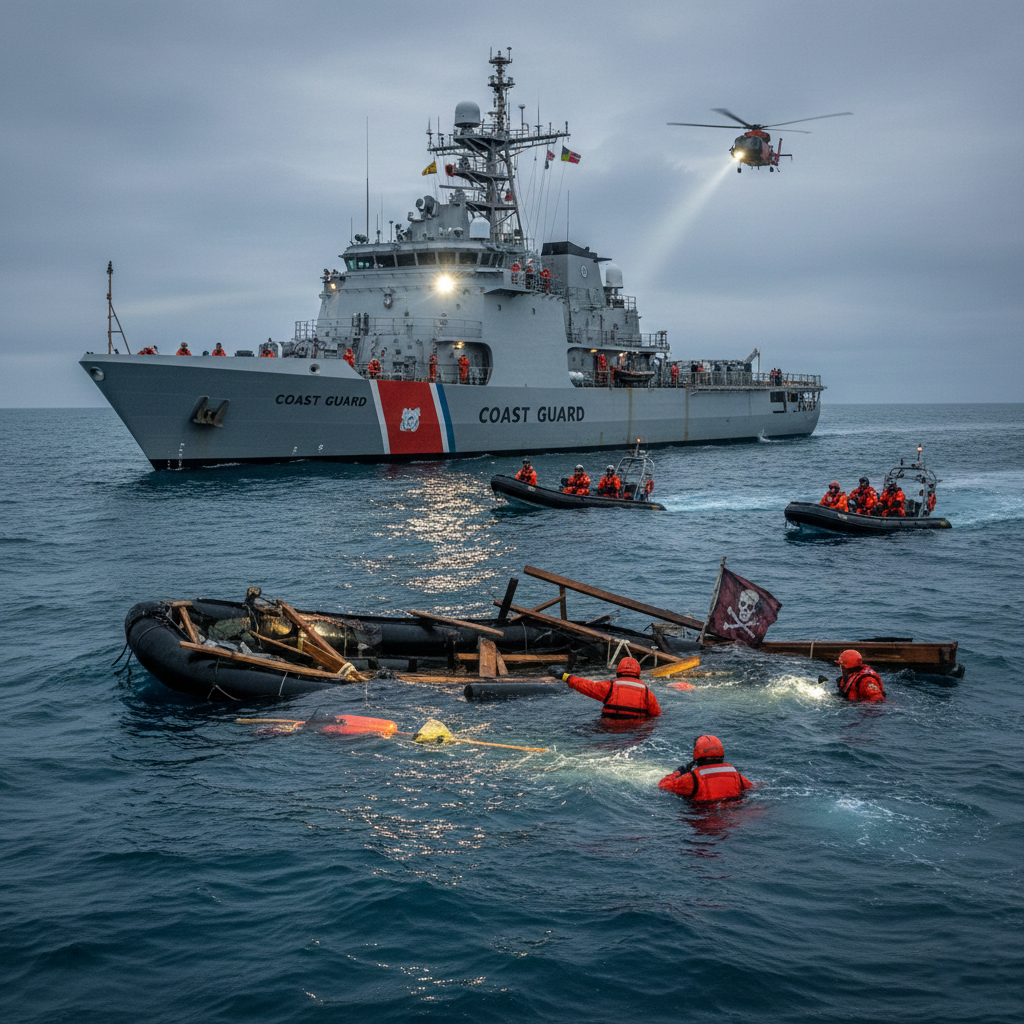
The US Coast Guard search for survivors after attacks on an alleged drug boat has triggered renewed attention on the dangers faced by maritime security forces and the growing risks linked to international drug trafficking at sea.
Following reports of violent confrontation involving a suspected narcotics vessel, Coast Guard teams were rapidly deployed to locate survivors, assess damage, and secure the surrounding waters. The incident underscores how drug smuggling operations continue to pose a serious threat—not just to law enforcement, but to civilian safety and regional stability as well.
As details continue to emerge, the response highlights the Coast Guard’s critical role in maritime law enforcement, humanitarian rescue, and national security.
What Happened: Incident Overview at Sea
The confrontation reportedly occurred during a routine maritime interdiction mission targeting a vessel suspected of transporting illegal drugs.
Key details reported so far include:
- The vessel was flagged due to suspicious movement patterns
- Coast Guard units attempted interception
- The situation escalated into a violent encounter
- The alleged drug boat sustained severe damage
- Several individuals were reported missing after the attack
While investigations are ongoing, officials confirmed that search-and-rescue operations were immediately launched, prioritizing human life over enforcement outcomes.
US Coast Guard’s Immediate Response
The US Coast Guard is trained to respond to complex maritime emergencies, including hostile encounters at sea.
Actions taken during the response included:
- Deployment of rescue boats and aircraft
- Expanded search radius due to rough sea conditions
- Coordination with regional maritime authorities
- Medical readiness teams placed on standby
According to Coast Guard protocols, every maritime interdiction includes contingency planning for rescue, especially in cases involving suspected criminal activity.
For official updates and maritime safety guidelines, readers can visit the US Coast Guard’s official website (uscg.mil).
Why Drug Trafficking at Sea Is So Dangerous
Maritime drug trafficking remains one of the most dangerous criminal enterprises globally.
Major risks involved:
- Armed resistance from traffickers
- High-speed chases in unpredictable waters
- Poor vessel conditions
- Risk of explosions or sinking
- Threats to innocent fishermen and commercial shipping
Smugglers often operate modified boats that prioritize speed over safety, increasing the likelihood of accidents when intercepted.
Search and Rescue: A Race Against Time
Once a vessel is damaged at sea, survival windows are extremely short.
Critical factors affecting survival:
| Factor | Impact |
|---|---|
| Water temperature | Hypothermia risk |
| Weather conditions | Reduced visibility |
| Time in water | Rapid fatigue |
| Protective gear | Improves survival odds |
Coast Guard rescue crews are trained to work under extreme pressure, often operating around the clock during high-risk missions.
International Waters, International Challenges
Many alleged drug boats operate near or across international maritime boundaries, making enforcement complex.
Legal and operational challenges include:
- Jurisdictional limitations
- Coordination with foreign navies
- Evidence preservation
- Human rights compliance
These operations often involve multinational task forces, especially in regions known for high smuggling activity.
Coverage of similar global maritime security challenges can also be found on thenews.zone, which tracks international law enforcement and defense developments.
Human Cost Behind Maritime Drug Crimes
While drug trafficking is often discussed in terms of seizures and arrests, the human cost is frequently overlooked.
Victims include:
- Crew members forced into smuggling roles
- Young recruits promised quick money
- Families left without answers after disappearances
- Rescue teams exposed to danger
The Coast Guard has repeatedly emphasized that saving lives remains the top priority, even during criminal interdictions.
Technology Used in Maritime Search Operations
Modern rescue missions rely heavily on advanced technology.
Tools commonly used:
- Thermal imaging cameras
- Night-vision aircraft
- Satellite tracking
- Radar mapping
- Emergency locator beacons
These technologies significantly improve detection rates but do not eliminate risks—especially in hostile encounters.
For deeper insights into maritime surveillance advancements, trusted global reporting can be found at reuters.com.
Rising Trend of Violent Smuggling Encounters
In recent years, authorities have reported an increase in violent resistance during drug interdictions.
Reasons behind this trend:
- Higher profits from narcotics trade
- Increased law enforcement pressure
- Sophisticated smuggling networks
- Militarization of criminal groups
This shift has forced maritime agencies to balance enforcement strength with humanitarian responsibility.
Role of the US Coast Guard Beyond Enforcement
The Coast Guard’s mission extends far beyond stopping illegal drugs.
Core responsibilities include:
- Search and rescue
- Environmental protection
- Port security
- Maritime safety inspections
- Disaster response
Incidents like this reinforce why the Coast Guard is often described as both a military force and a humanitarian service.
More coverage on national security roles can be explored through analysis on thenews.zone.
Public and Policy Reactions
Such incidents often prompt renewed debate around:
- Drug policy effectiveness
- Border security funding
- Maritime safety investments
- International cooperation
Lawmakers and security experts alike have called for stronger intelligence sharing to prevent violent confrontations before they occur.
FAQs
What triggered the US Coast Guard search operation?
The search began after a violent encounter involving a vessel suspected of drug trafficking, which left several individuals unaccounted for at sea.
Are survivors often found after such incidents?
Survival depends on weather, response time, and safety equipment. Rapid Coast Guard deployment significantly increases rescue chances.
Why are drug boats so hard to intercept?
They are often high-speed, lightly built, and operated by experienced crews willing to take extreme risks.
Does the Coast Guard prioritize arrests or rescue?
Rescue always comes first. Saving lives is the Coast Guard’s primary mission, regardless of criminal involvement.
Where can I read verified updates on maritime incidents?
Reliable information can be found on uscg.mil, reuters.com, and trusted news platforms like thenews.zone.
Conclusion: A Reminder of the Risks at Sea
The US Coast Guard search for survivors after attacks on an alleged drug boat serves as a stark reminder of the dangers unfolding far from shorelines and headlines.
Behind every seizure or interception is a high-risk operation involving real people, unpredictable conditions, and life-or-death decisions. As investigations continue, the incident reinforces the importance of maritime security, international cooperation, and unwavering commitment to human life.
👉 For ongoing coverage, expert analysis, and global security updates, stay informed with trusted reporting on thenews.zone.
