

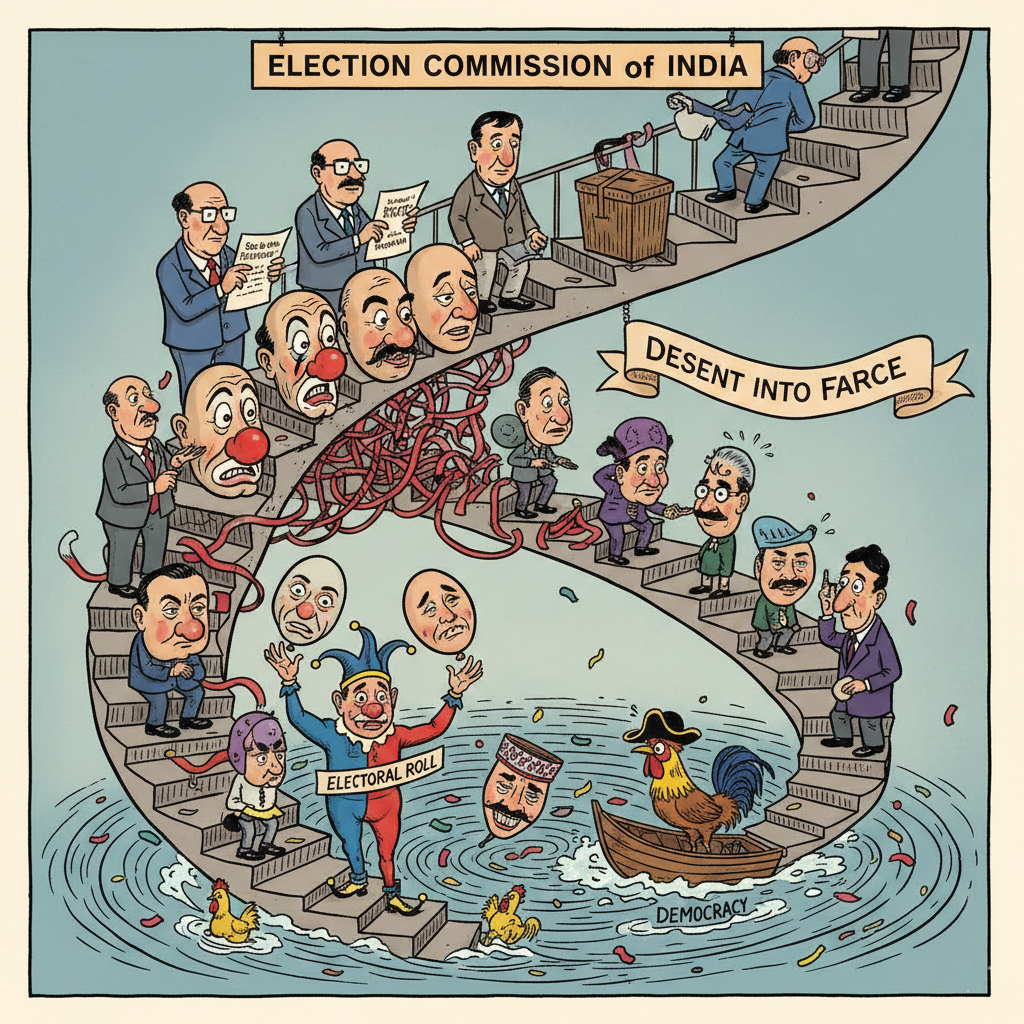
The Election Commission of India (ECI) stands as one of India’s most crucial constitutional bodies, entrusted with the responsibility to ensure free, fair, and transparent elections. Yet, recent developments around the Special Intensive Revision (SIR) of electoral rolls have triggered a fierce debate across the political spectrum, media, and civil society. This highly contentious exercise — intended to update and “clean” voter lists — has been labeled by critics as a descent into farce, raising questions about its execution, intent, and impact on India’s democratic framework.
This article explores the SIR controversy in depth: what it is, why it matters, why it has become so polarizing, and what it means for the future of Indian democracy. We will also look at key arguments, legal challenges, data insights, stakeholders’ positions, and frequently asked questions.
What is the Special Intensive Revision (SIR) by the Election Commission of India?
The Special Intensive Revision (SIR) is a process initiated by the Election Commission of India to update the electoral rolls across states and Union Territories, beginning with Bihar in mid‑2025. Unlike regular summary revisions, SIR is a more comprehensive review of voter lists with a focus on:
- Verification of voter eligibility
- Removal of duplicate or ineligible entries
- Ensuring accuracy of demographic details
- Linking current voter details to older rolls (dating back to 2002)
The goal, as articulated by the ECI, is to enhance the integrity and accuracy of the electoral database. However, the method, pace, and implications have sparked widespread debate.
Why the SIR Sparked Controversy
Shifting Burden of Proof and Citizenship Questions
One of the most contested aspects of the SIR exercise is its emphasis on documentary verification of citizenship and linkage with older voter rolls. Critics argue that this effectively places the burden of proof on citizens and equates the exercise with a National Register of Citizens (NRC)‑style scrutiny, even though the ECI maintains it is solely updating the electoral rolls under its constitutional mandate.
Mass Deletions from Voter Lists
Across the first phase of SIR, reports suggest that crores of names have been removed from the electoral rolls, leading to public outcry and political backlash. Opposition leaders have accused the ECI of disenfranchising voters — particularly from marginalized communities — deliberately or through flawed procedures. The Economic Times
Questions Over Transparency and Technology Use
Critics, including political leaders and civil society activists, have raised concerns about the lack of transparency concerning the tools and applications used in the SIR, including alleged use of AI‑based verification systems with opaque details.
Political Fallout and Legal Challenges
Political parties from different sides have positioned the SIR debate as either a defensive fight for electoral integrity or an attack on democracy. Leaders like P Chidambaram have asserted that the ECI is behaving more like a judicial body and not addressing complaints fairly.
Many parties have also taken legal paths, questioning the constitutional validity of the SIR, and the matter is being heard in the Supreme Court.
Timeline: Key SIR Developments
| Date/Period | SIR Milestone |
|---|---|
| June 24, 2025 | ECI announces SIR beginning with Bihar. |
| August‑September 2025 | Nationwide rollout plans and political criticisms intensify. |
| Late 2025 | SIR Phase‑2 expands to several states and UTs. |
| Early 2026 | Legal challenges and Supreme Court hearings continue. |
Key Stakeholders & Their Positions
Election Commission of India (ECI)
The ECI defends the SIR as a constitutional duty under Article 324 to maintain accurate electoral rolls and rejects allegations that the process is politically motivated or discriminatory. It has described many accusations as “exaggerated” or “misconceived.”
Opposition Political Parties
Several political leaders and parties — including Congress, TMC, and regional unions — argue that the SIR undermines voter confidence and could be used to selectively remove names from voter lists. Some have even labelled the exercise as a covert form of NRC.
Civil Society and Legal Experts
Activists and legal scholars have raised concerns about shifting the burden of proof for citizenship and argued that the exercise could be arbitrary or discriminatory if not implemented with deep safeguards. cdn.countercurrents.org
The Public
Many citizens have expressed confusion and frustration due to documentation requirements, long queues, and uncertainty over whether domicile certificates or other proofs will be accepted — sparking widespread debate on social platforms and grassroots discussions.
Data Snapshot: SIR’s Scale and Impact
| Data Point | Figure / Insight |
|---|---|
| Electors Covered | ~6.41 crore (in Tamil Nadu’s digitalised SIR process) |
| Estimated Names Removed | Over 3 crore names from rolls in initial phases. |
| States Affected | Multiple states and UTs including Bihar, West Bengal, Tamil Nadu, Kerala, and more. |
Comparison: Regular vs. Special Intensive Revision
| Aspect | Regular Summary Revision | Special Intensive Revision (SIR) |
|---|---|---|
| Frequency | Scheduled periodically | Can be initiated at ECI’s discretion |
| Depth of Review | Moderate adjustments | Comprehensive voter verification |
| Documentary Proof | Limited requirements | Extensive documentation needed |
| Public Controversy | Minimal | Extremely high |
| Political Impact | Low | High |
Legal and Constitutional Debate
At the core of the legal argument is whether the ECI has the authority to conduct SIR with strict documentary verification and whether insisting on detailed documentation conflicts with constitutional principles guaranteeing universal franchise and equality before the law. Many petitions currently before the Supreme Court focus on these issues.
The ECI asserts its “exclusive jurisdiction” over electoral roll revisions, while critics question the foundations and fairness of the current SIR protocol.
Internal Link
For more political and electoral analysis, visit thenews.zone to stay updated on developments around democracy and governance in India.
FAQs About the ECI and SIR
1. What exactly is the Special Intensive Revision (SIR)?
SIR is a thorough review and update of the electoral rolls initiated by the ECI to ensure accurate and updated voter lists, involving documentary verification and linkage to older records. It differs from routine summary revisions by its depth and scope.
2. Is SIR constitutional?
The constitutional validity of SIR is currently under review by the Supreme Court, with arguments on both sides regarding ECI’s authority and democratic safeguards
3. How many voters have been removed from rolls under SIR?
Reports indicate that over three crore names have been removed or flagged during the SIR process across the initial phases.
4. Can this affect elections?
Yes. Changes to electoral rolls ahead of major state and national polls can potentially influence electoral outcomes and voter representation.
5. Where can citizens verify their status?
Citizens can check official ECI portals and follow notices issued by Booth Level Officers (BLOs) and Electoral Registration Officers (EROs), although technical issues and confusion have been reported.
For authoritative updates, you can refer to the Election Commission of India official website: https://eci.gov.in
Conclusion
The descent into farce narrative around the Election Commission of India and its Special Intensive Revision (SIR) reflects deep divisions in how critical democratic processes are perceived today. While the ECI insists on its constitutional duty and the need to maintain accurate electoral rolls, critics see in SIR a troubling shift towards exclusion, confusion, and political polarization.
This debate has profound implications for the future of India’s democracy. It highlights how important election administration is not just in mechanics, but in public trust, legal frameworks, and civic engagement.
