
A High-Stakes Move That Shakes the World
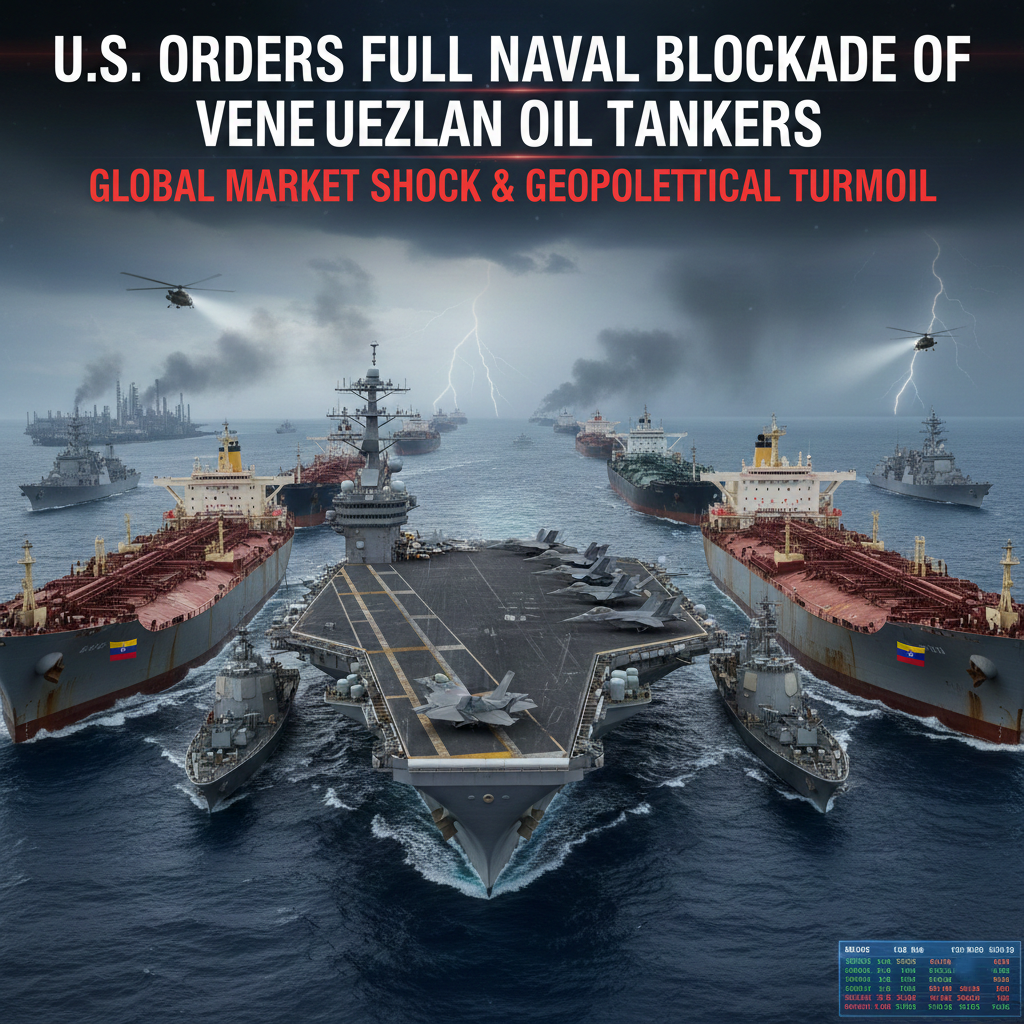
In a dramatic escalation of U.S.–Venezuela tensions, the United States has reportedly ordered a full naval blockade of Venezuelan oil tankers, aiming to choke off a crucial revenue stream for President Nicolás Maduro’s government. The move marks one of the most aggressive steps Washington has taken against Caracas in years, instantly sending shockwaves through global oil markets, energy security planning, and international geopolitics.
This decision, widely reported and debated across global media, signals a shift from economic pressure to direct maritime enforcement, raising urgent questions about legality, enforcement, retaliation, and the broader impact on an already fragile global economy.
From rising oil prices to diplomatic fallout involving Russia, China, and regional Latin American powers, the ripple effects are being felt far beyond the Caribbean. This article breaks down what the blockade means, why it matters now, and how the world is reacting—in clear, human language designed to help readers understand one of the most consequential geopolitical developments of the year.
What the U.S. Naval Blockade of Venezuelan Oil Means in Practice
A naval blockade is not just a symbolic gesture. It is a military-enforced restriction on maritime trade, particularly severe when applied to energy exports.
How a Naval Blockade Works
In simple terms, a full naval blockade involves:
- U.S. naval forces monitoring key shipping lanes
- Intercepting, inspecting, or turning back oil tankers
- Preventing Venezuelan crude from reaching foreign buyers
- Enforcing compliance through the threat of force
Unlike financial sanctions, which operate through banks and corporations, a blockade physically stops oil from moving.
Why Venezuelan Oil Is the Target
Oil remains the backbone of Venezuela’s economy:
| Metric | Approximate Figure |
|---|---|
| Share of export revenue | 90%+ |
| Daily oil production | 700,000–800,000 barrels |
| Key buyers | China, intermediaries in Asia |
| State oil company | PDVSA |
By cutting off oil exports, the U.S. aims to sever the financial lifeline sustaining the Maduro government.
Why the U.S. Escalated Now: Strategic and Political Drivers
Pressure on the Maduro Government
Washington has long accused President Maduro of:
- Undermining democratic institutions
- Manipulating elections
- Human rights abuses
- Corruption within state industries
Previous tools—sanctions, asset freezes, diplomatic isolation—have failed to dislodge the regime. The blockade suggests U.S. policymakers believe economic pressure alone is no longer sufficient.
Domestic and Regional Calculations
Several strategic factors may have influenced the timing:
- U.S. election cycle pressure to appear tough on authoritarian regimes
- Migration concerns, as Venezuela’s crisis fuels regional instability
- Energy leverage, with oil markets already sensitive due to global conflicts
The blockade sends a message not only to Caracas but also to other sanctioned states watching closely.
Immediate Impact on Global Oil Markets
Markets reacted sharply as news of the blockade spread.
Oil Prices Surge on Supply Fears
Even though Venezuela is not a top global producer, markets are forward-looking.
Key market reactions include:
- Brent crude prices jumping 3–5% in early trading
- Increased volatility in energy futures
- Higher insurance premiums for tankers in the Caribbean
- Renewed fears of supply chain disruptions
Traders understand that geopolitical risk premiums can push prices higher even when actual supply losses are modest.
Why Markets Care About Venezuelan Oil
Venezuelan crude is heavy and sour, critical for:
- U.S. Gulf Coast refineries
- Asian refineries configured for heavy crude
- Blending operations that stabilize fuel outputs
Removing it from circulation creates refinery mismatches and costlier substitutes.
Legal and International Law Controversy
A naval blockade raises complex legal questions under international maritime law.
Is a Blockade Legal Without War?
Under international law:
- Blockades are typically acts of war
- They require justification under self-defense or UN authorization
- Unilateral enforcement is highly controversial
Critics argue the move risks:
- Violating freedom of navigation
- Setting a dangerous global precedent
- Escalating tensions beyond diplomatic repair
Supporters counter that national security and sanctions enforcement justify extraordinary measures.
Venezuela’s Response: Defiance and Diplomatic Countermoves
President Maduro’s government has reacted with predictable fury.
Caracas Condemns the Blockade
Venezuela has:
- Accused the U.S. of “economic warfare”
- Claimed the blockade violates international law
- Warned of “serious consequences”
- Sought emergency regional and international support
State media portrays the move as an attack on Venezuelan sovereignty.
Potential Retaliation Scenarios
While Venezuela’s military capabilities are limited, possible responses include:
- Legal challenges in international courts
- Appeals to allies for escorting tankers
- Cyber or asymmetric responses
- Disruptive actions in regional diplomacy
China, Russia, and Global Powers React
China’s Strategic Concerns
China is one of Venezuela’s largest oil customers and creditors.
Beijing may view the blockade as:
- A threat to energy security
- A challenge to global trade norms
- Another example of U.S. unilateralism
While unlikely to engage militarily, China could:
- Increase diplomatic pressure
- Use intermediaries and shadow shipping
- Strengthen alternative payment systems
Russia’s Geopolitical Angle
Russia sees Venezuela as:
- A strategic partner in the Western Hemisphere
- A counterweight to U.S. influence
Moscow has criticized the move and may exploit it rhetorically to highlight what it calls “Western hypocrisy.”
Impact on Latin America and the Caribbean
Regional Governments Caught in the Middle
Neighboring countries face difficult choices:
- Support U.S. pressure or maintain neutrality
- Manage refugee flows
- Protect regional trade routes
Some Caribbean nations depend on Venezuelan oil under preferential arrangements, making the blockade economically painful.
Risk of Regional Instability
Potential consequences include:
- Increased fuel prices across Latin America
- Heightened political polarization
- Renewed migration waves
- Diplomatic fragmentation in regional blocs
How the Blockade Affects Ordinary Venezuelans
While aimed at the government, the human cost cannot be ignored.
Economic Pain on the Ground
Reduced oil revenue often leads to:
- Currency depreciation
- Inflation spikes
- Cuts to social programs
- Shortages of fuel and basic goods
Critics argue that ordinary citizens bear the brunt, not political elites.
Humanitarian Debate Intensifies
Human rights groups warn that:
- Broad economic restrictions worsen humanitarian crises
- Access to medicine and food may decline
- Sanctions without relief mechanisms can backfire
This debate is now central to international responses.
Comparison: Naval Blockade vs Economic Sanctions
| Factor | Naval Blockade | Economic Sanctions |
|---|---|---|
| Speed of impact | Immediate | Gradual |
| Enforcement | Military | Financial/legal |
| Legal risk | High | Moderate |
| Civilian impact | High | High |
| Global market shock | Severe | Moderate |
The blockade represents a hard-power escalation rarely used in modern geopolitics.
Long-Term Geopolitical Implications
A Dangerous Precedent?
Analysts warn the move could:
- Normalize military enforcement of sanctions
- Encourage similar actions by other powers
- Undermine multilateral institutions
If blockades become a standard tool, global trade could face lasting instability.
Energy Security Rewritten
The episode reinforces a harsh reality:
Energy remains a weapon in global power struggles.
Countries may now accelerate:
- Energy diversification
- Strategic petroleum reserves
- Regional energy alliances
Frequently Asked Questions (FAQs)
What is the main goal of the U.S. naval blockade of Venezuelan oil?
The primary goal is to cut off oil revenue that funds President Maduro’s government, increasing pressure for political change.
Will this blockade cause oil prices to rise globally?
Yes. Even limited supply disruptions increase market volatility, risk premiums, and fuel price uncertainty.
Is the blockade considered an act of war?
Not officially, but under international law, naval blockades are traditionally associated with warfare, making this move highly controversial.
How might Venezuela bypass the blockade?
Possible methods include ship-to-ship transfers, reflagging vessels, using intermediaries, or relying on diplomatic escorts—though all carry risks.
Who is most affected by this escalation?
Beyond governments, ordinary Venezuelans, regional economies, and global energy consumers feel the impact through inflation and instability.
Conclusion: A Turning Point in Energy and Power Politics
The U.S. decision to order a full naval blockade of Venezuelan oil tankers marks a turning point in modern geopolitical strategy. It transforms long-running economic pressure into a direct confrontation at sea, with consequences that stretch far beyond Venezuela’s shores.
As oil markets react, global powers reposition, and humanitarian concerns grow louder, one truth becomes clear: this is not just about Venezuela. It is about how power is exercised in a fragmented world, where energy, security, and politics are inseparable.
The coming weeks will determine whether this escalation forces meaningful change—or ignites a broader crisis with lasting global consequences.
